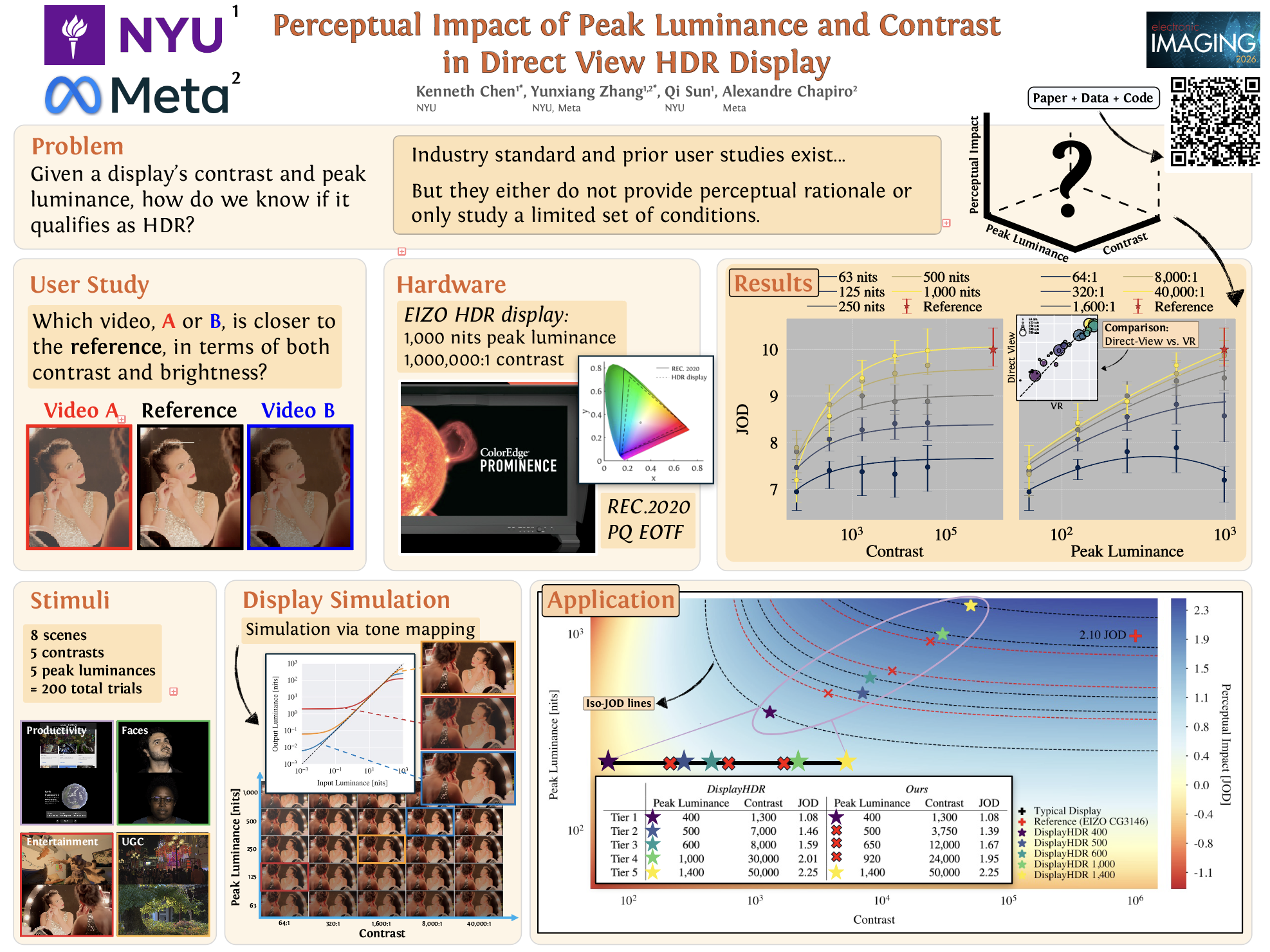
In this plot, we show that the existing standard for HDR, DisplayHDR, is not spaced in equal perceptual units (JODs) as defined by our model. Red X marks are equally spaced as evaluated by this model.
Abstract
Characterization of a high dynamic range (HDR) display's performance can be largely defined by its contrast and peak luminance. Prior work has studied this question for virtual reality (VR) using a haploscopic HDR setup, but it is not obvious if those results are transferrable to a more traditional viewing setting, such as direct view. In this work, we conducted a study to measure user preference for different contrast and peak luminance parameters in this scenario, and develop a perceptual just-objectionable-difference (JOD) scale to quantify preference scores. This is accomplished by studying contrast and peak luminance conditions across several orders of magnitude, shown on a professional HDR display with peak luminance of 1,000 nits and 1,000,000:1 contrast. The data is used to develop a computational model that can drive display design and future standardization of the definition of HDR, in terms of human preference.